
If you’re interested in cybersecurity and want to learn a bit of terminal commands, coding, or CTFs, Blackdoor is a game worth checking out. I work in IT as a cybersecurity analyst, and I had been meaning to get back into coding and CTFs. Blackdoor, developed by Static Signal, has been a great way to refresh those skills and reignite my interest.
The game puts you in front of a terminal and lets you figure things out. You write scripts, test commands, investigate servers, and learn through trial and error. It can feel overwhelming at first, but that freedom is part of what makes the game fun.
For me, Blackdoor was more than a CTF-style game; it reminded me why I enjoyed coding and problem-solving in the first place. Hopefully it can be yours too, so let’s take a look at what this game is about.
In the Terminal
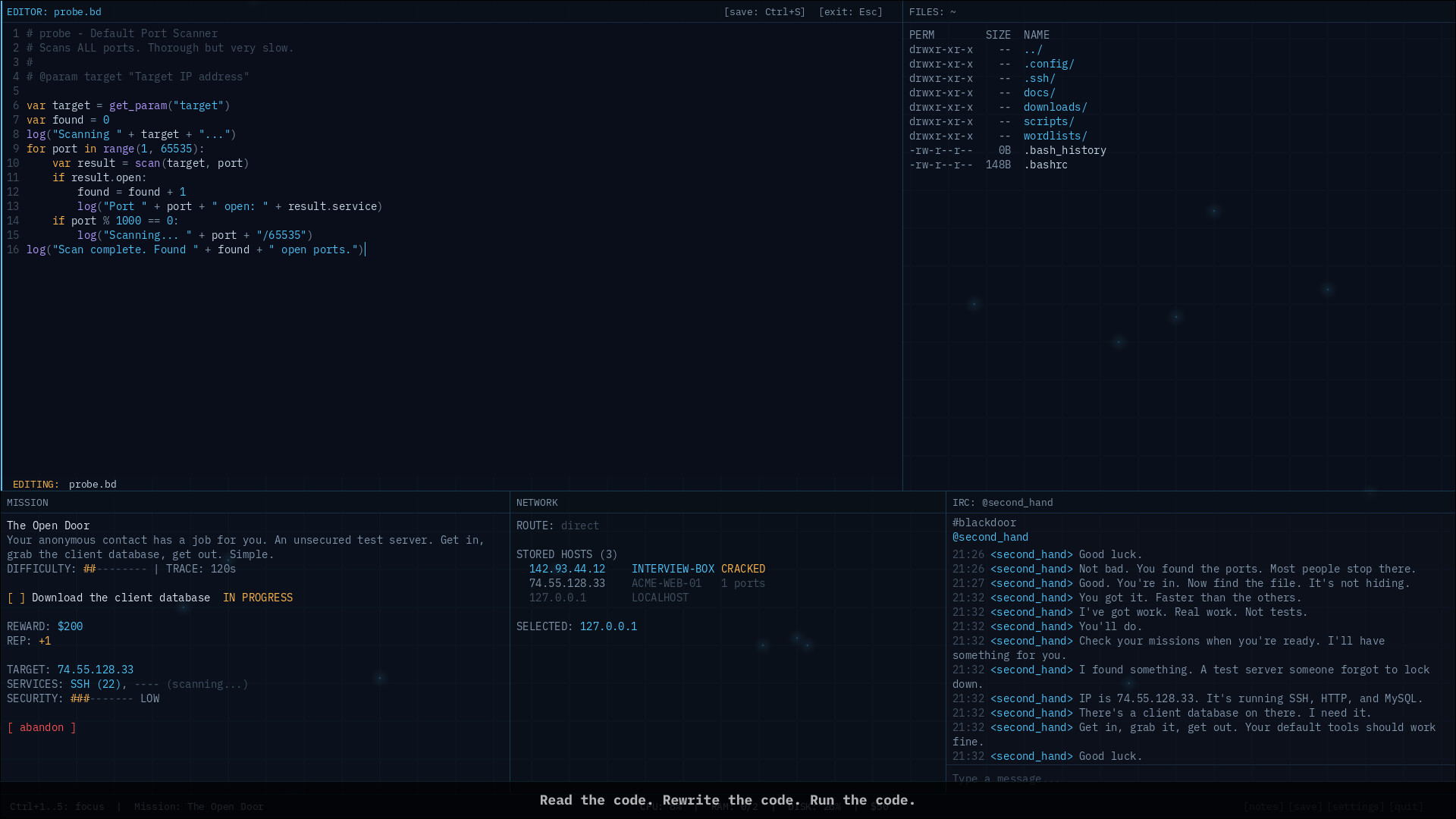
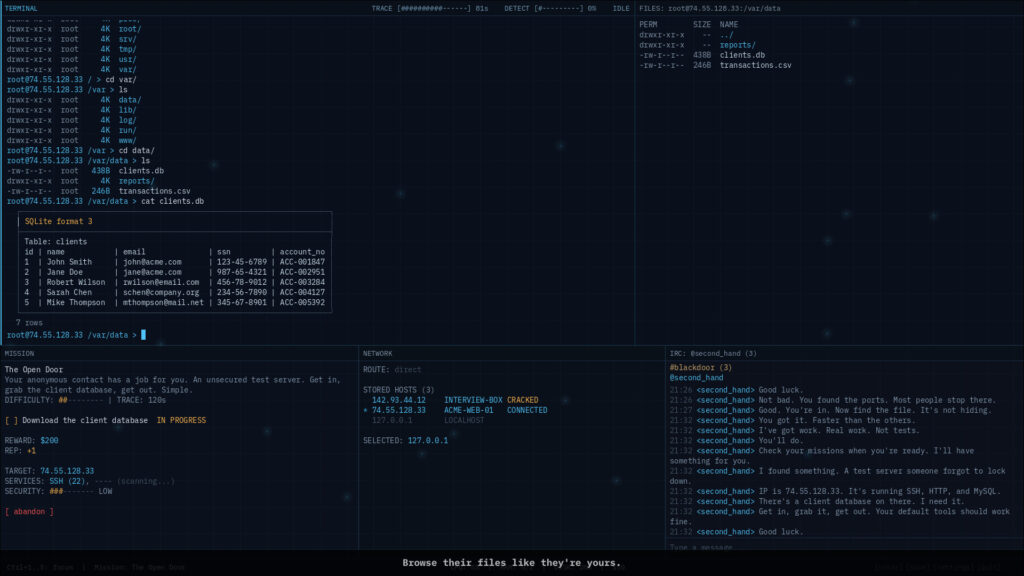
The first thing that stands out about Blackdoor is its interface. This is not a hacking game disguised as a few menus. You work in an actual terminal environment, complete with command history, tab completion, a code editor, and a set of commands you use to interact with servers. Of course, it is not a fully accurate representation, but it is close to what you might experience in a real-life environment.
The game gives you scripts that can accomplish basic tasks, but they are intentionally inefficient. For example, an initial port scanner checks all 65,535 ports. It works, but it is slow and creates unnecessary noise. The password cracker has a similar problem because it relies on brute force, which can attract the attention of intrusion detection systems.
The solution is not simply finding a better button to press. You rewrite the tools yourself. It is a challenge in itself; you do not know where to begin, though there is plenty of documentation on the web.
You can write your own scripts and watch them execute line by line inside the game. Seeing your code actually perform a task is satisfying, especially when a script that initially fails eventually starts working after several rounds of testing and changes.
It is also where the game demands patience. Writing a script is rarely as simple as having an idea and immediately watching it succeed. You need to test commands, identify errors, change the code, and test again. That process can be frustrating, but it gives the game a sense of earned progression.
The Learning Curve
Blackdoor does not hold your hand much, and that can be both its biggest strength and its biggest obstacle.
If you are already comfortable with Linux commands or basic programming concepts, the game’s Python-like scripting language should feel approachable. Variables, loops, functions, and other programming concepts become tools you can use, not topics explained through lengthy tutorials.
For someone with little or no programming experience, however, it can still feel intimidating. You are essentially learning by doing. The game provides working examples you can improve, but it doesn’t always tell you exactly how.
That makes Blackdoor particularly suited to curious players who enjoy experimenting and exploring. You might spend time trying to understand why a command works in one situation but not another, or why a script that looks correct refuses to behave the way you expected.
The game also creates a useful connection between Linux-style commands, programming, and cybersecurity concepts. It is not a replacement for actually learning cybersecurity, but it can give players a reason to become interested in those subjects. Someone who wants to learn more about Linux commands or get a taste of cybersecurity may find themselves looking up concepts simply because they need them to solve the next problem.
Every Server Is a Problem to Solve
The campaign starts with relatively straightforward jobs and gradually introduces more complicated environments. You may begin by investigating a basic server before eventually dealing with corporate networks, multiple users, privilege escalation, intrusion detection, encrypted files, and restricted services.
The interesting part is that the game does not force you toward a single solution.
You might brute-force a password, find credentials sitting in a poorly protected file, or write a script that approaches the problem from an entirely different direction. The tools available to you are there to be combined however you see fit. This is especially true for me, since I found a solution I didn’t expect to work.

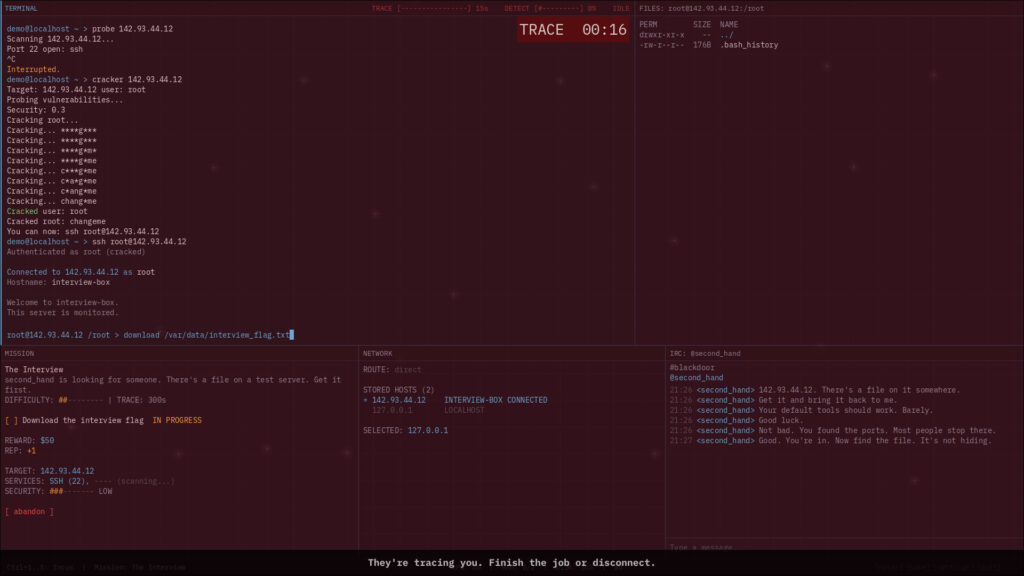
The trace system also adds pressure, which I find frustrating at times. Connections create a countdown that can accelerate when you make too much noise. Getting traced ends the attempt, so inefficient scripts aren’t merely inconvenient. They can actively make a job harder.
This gives your code a practical purpose. Writing a faster script helps if you know where to look, but it also shows you leave traces behind, such as history and log details. So the less noise you make, the better.
Final Thought
Blackdoor also has other elements, like NPCs and a story, to make it more fun than just giving you tasks to complete. There are other cool features to discover, and if you are interested in this game, I will let you find them out.
The game makes cybersecurity concepts approachable without turning them into simple button presses. You are encouraged to explore, experiment, and learn through failure.
If you are interested in CTF-style challenges, Linux, programming, or cybersecurity, Blackdoor has plenty to offer. It is especially well-suited to curious players who aren’t afraid to keep trying when their first solution doesn’t work.