
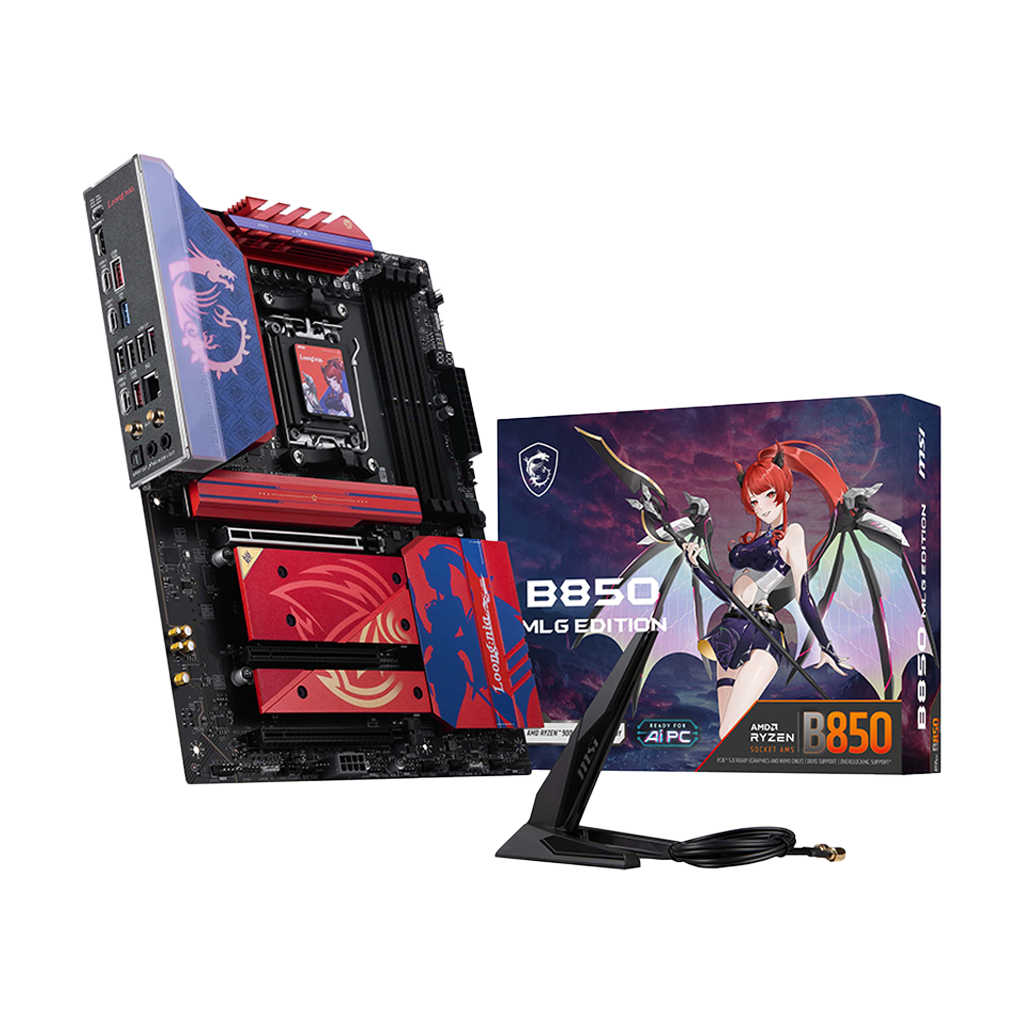

In gaming, everyone remembers the moments that make you stop and think, “This just feels right.” It might be a perfect headshot, a flawless combo, or that first boot-up on a freshly built PC when everything works. The MSI MAG B850 Tomahawk Max WiFi MLG Edition gave me that kind of moment. It’s a board that commands respect through balance, consistency, and innovative design. And it just so happens that I have two of these boards now.
I previously reviewed the standard MAG B850 Tomahawk Max WiFi for MP1st.com, a board that impressed me for its stability and practicality, especially in the mid-tier range. After seeing how well it performed in my own setup, I decided to grab the new MLG Edition for my wife’s PC build. What I discovered is that MSI didn’t just release a new color scheme or slap a logo on it. The MLG Edition fine-tunes the Tomahawk experience into something that feels more complete, more confident, and far more ready for the future of gaming and computing.
This review dives deep into what makes the B850 MLG Edition a mid-tier powerhouse, how it performs under pressure, and why I think it’s one of the smartest buys on the AM5 platform right now.
Design and Build Quality – MLG Version
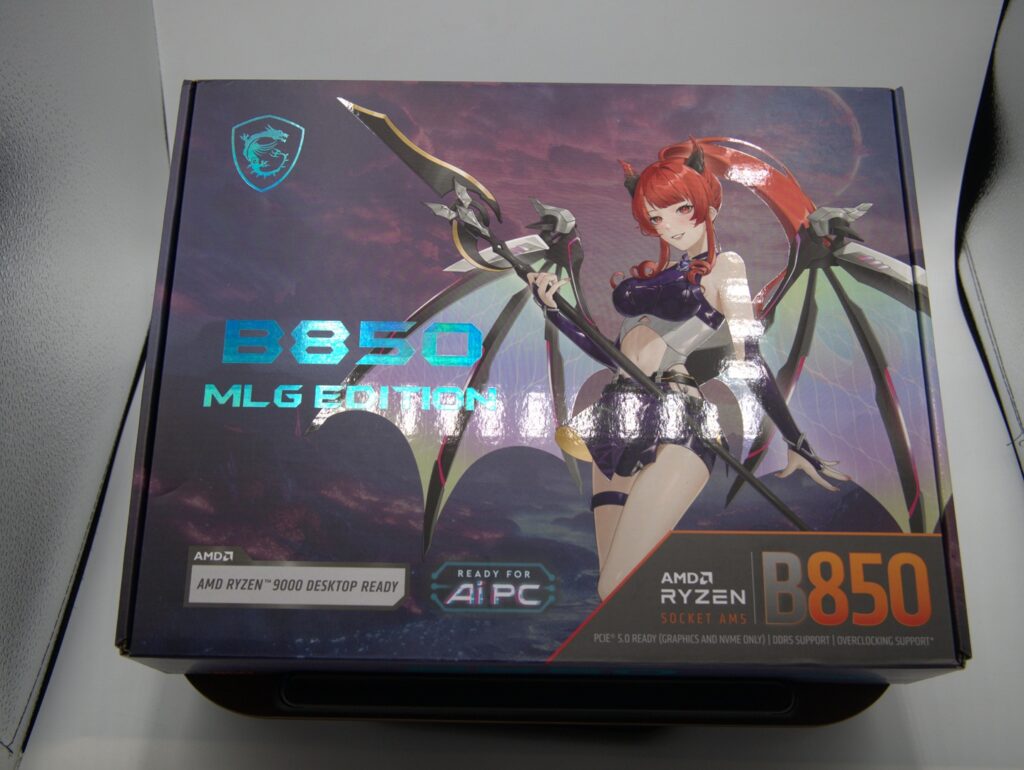
When you first unbox the B850 MLG Edition, it’s clear MSI has done a fantastic job creating a theme and aesthetic for this motherboard. MSI leans into their Loong: Nia motif here, pairing deep black with subtle red highlights that give the board personality without overwhelming the eye. Heavy-duty Frozr heatsinks and clean structural lines reinforce the sense of quality and purpose. This board fits just as well in a competitive gaming rig as in a clean workstation setup.
MSI’s design choices go beyond aesthetics. Headers are easy to reach, the four M.2 slots are protected with EZ M.2 Shield Frozr II, and the EZ PCIe Release and EZ Antenna make installation and adjustments painless. Every element seems thought through, minimizing the everyday frustrations of cable management and component placement.
Under the hood, the board’s 14+2+1 Duet Rail Power System with 80A Smart Power Stages proves it’s more than just a pretty face. Testing with a Ryzen 7 9700X and 32GB DDR5-7200 showed smooth, stable power delivery with no voltage spikes or throttling. CPU boost clocks remained consistent under load, and VRM temperatures stayed in check even during extended benchmarks, which included Cinebench R24 and 3DMark CPU Profile runs. Memory overclocking with EXPO profiles was stable from the start, and enabling High-Efficiency Mode slightly improved bandwidth and latency.
The combination of thoughtful design and robust power delivery gives this mid-tier board the headroom to handle demanding CPUs and memory configurations, allowing it to perform consistently under both gaming and productivity loads. You get a board that looks cohesive, feels solid in your hands, and delivers reliable performance from the first boot.
Connectivity, Expansion, and Everyday Experience
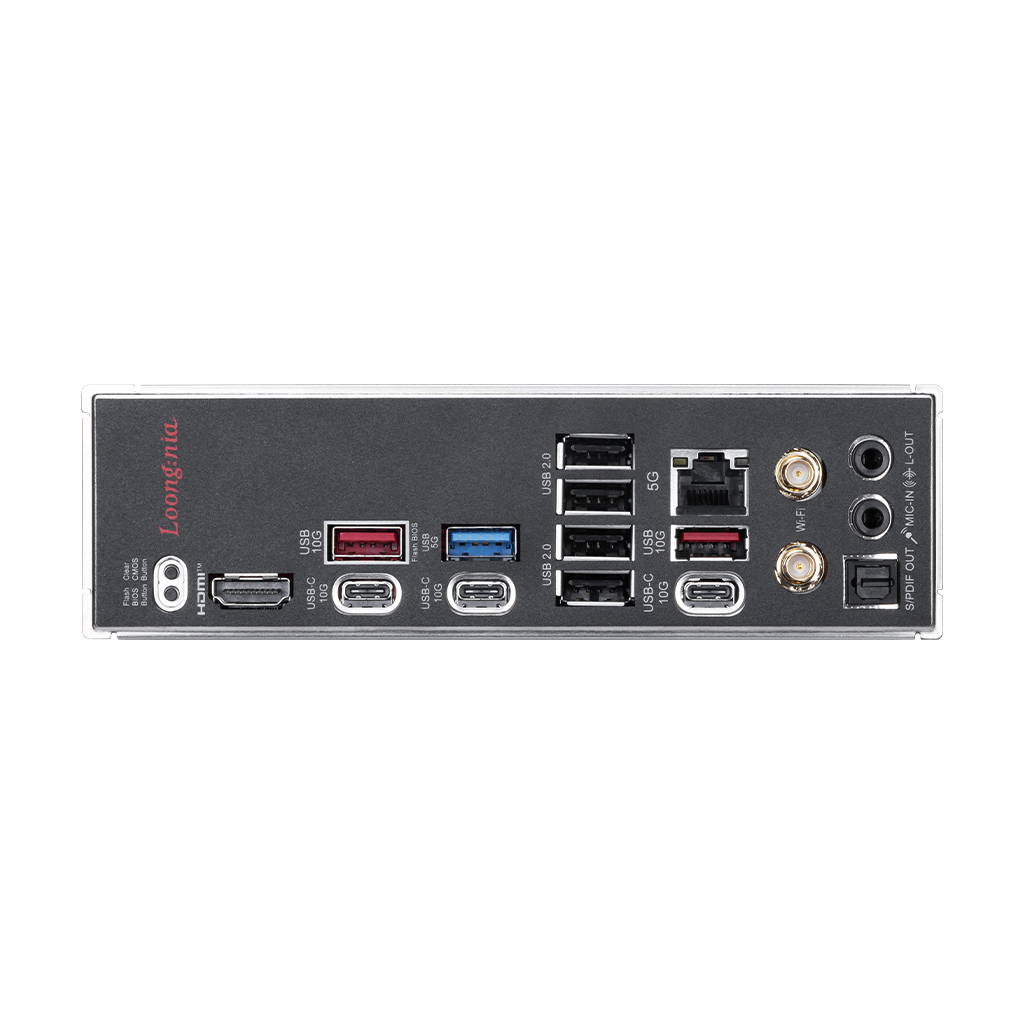
MSI designed the B850 MLG Edition to handle both current and future hardware needs without overcomplicating things. You get a PCIe 5.0 x16 slot for next-gen GPUs, two Gen5 x4 M.2 slots, and two additional Gen4 M.2 slots for extra storage flexibility. Networking is equally great whether you’re wired or using the included EZ Antenna, with 5G LAN and Wi-Fi 7, delivering high-speed, low-latency connections.
The rear I/O is thoughtfully laid out. Multiple USB 10Gbps Type-A and Type-C ports coexist with 5Gbps Type-A and legacy USB 2.0, giving plenty of options for both new and older peripherals. Optical S/PDIF, Clear CMOS, and Flash BIOS buttons make troubleshooting and firmware updates easy, eliminating many of the small headaches builders often face. Lane sharing is handled intelligently via the primary PCIe 5.0 slot, which maintains full bandwidth even when both top M.2 drives are populated. In contrast, secondary slots remain flexible for additional storage or less intensive components.
Beyond raw connectivity, the board’s Audio Boost 5 delivers reliable, clean sound, suitable for gaming, streaming, and general media consumption. Headphones or speakers, the audio remained crisp and balanced, with positional cues in games like shooters precise enough to trust in competitive scenarios. Daily usage further underscores the board’s stability: boot times are quick, sleep and resume operations are predictable, and MSI Center allows intuitive fan control and thermal monitoring. Wi-Fi 7 and 5G LAN connections remained consistent even under simultaneous streaming and large file transfers, demonstrating that the B850 MLG Edition can handle mixed workloads.
Built Right, Tuned for Play
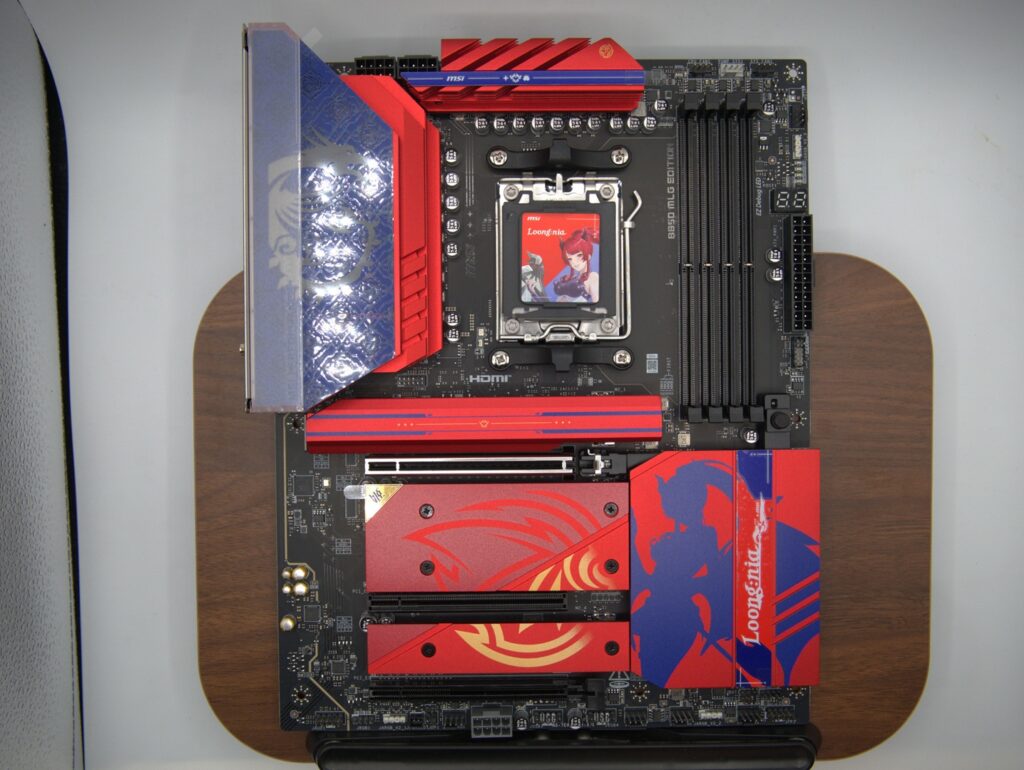
Building with the B850 MLG Edition feels like MSI learned all the right lessons from past generations. The layout is logical, the headers are accessible, and small touches like the EZ M.2 Clip II and EZ PCIe Release make a real difference during installation. These are the kinds of features you don’t appreciate until you’ve had to wrestle with a tiny screw falling into your case or a GPU that just won’t let go. On this board, it’s all painless; the component swaps and adjustments are quick and frustration-free.
Once the system was assembled, boot-up was fast and smooth. I dropped in a Ryzen 7 9700X, 32GB of DDR5-7200 memory, and an MSI GeForce RTX 5070 Ti 16G MLG EDITION OC (future review on this after testing it some more), then updated the BIOS to the latest release using the Flash BIOS Button. Within minutes, everything was ready to go. The BIOS interface itself is one of MSI’s strong suits. It’s intuitive and snappy, offering quick navigation between EZ and Advanced modes. For most users, that means it’s simple to enable EXPO memory profiles, fine-tune fan curves, or apply modest overclocks without having to dive into a maze of menus.
In my testing, the Frozr AI Cooling system was particularly effective. It automatically adjusted fan speeds based on both CPU and VRM thermals, maintaining stable temperatures without excessive noise. Even during stress tests with Cinebench R24 and sustained gameplay in CPU-heavy titles, fan noise never reached an annoying level.

Once everything was tuned, the B850 MLG Edition showed what it’s capable of. With the RTX 5070 Ti, this board delivered strong, consistent frame pacing across multiple titles. In Cyberpunk 2077 (Ultra settings, 1440p), the system maintained steady performance, hovering around 120–130 FPS with no signs of CPU throttling or VRM heat buildup. Apex Legends both showed the same stability, especially during extended sessions, even when lesser boards might show minor thermal drift or voltage drops.
Even more demanding simulation titles like Cities: Skylines II and Total War: Warhammer III (I should have also tried Civilization VII) ran without issue. The VRM design handled sustained boost clocks with ease, and DDR5 performance stayed consistent after hours of load. The board’s ability to keep power delivery smooth under load meant no unexpected dips or lag spikes, which is something you can see when panning the camera across large-scale maps or multitasking while gaming.
Networking performance deserves special mention. The integrated 5G LAN performed exceptionally well, maintaining low latency even during simultaneous online gameplay and file transfers. Switching to Wi-Fi 7 showed similarly impressive results. Download speeds were steady, and connection stability matched what you’d expect from a wired setup for outstanding wireless connectivity.
Thermals stayed predictable throughout testing. The VRM temperatures peaked in the mid-70s Celsius during full load, while CPU temperatures remained in the mid-70s to low 80s during sustained gaming sessions, well within safe limits for the 9700X. Even with multiple Gen5 M.2 drives installed, the enlarged Frozr heatsinks and M.2 Shield Frozr kept SSD temps in check, preventing throttling.
Overall, the gaming experience was precisely what you want from a mid-tier AM5 motherboard: consistent, stable, and predictable. There were no random crashes, no BIOS quirks, and no network dropouts. Every component worked harmoniously, a sign that MSI has refined its firmware and tuning process over multiple generations.